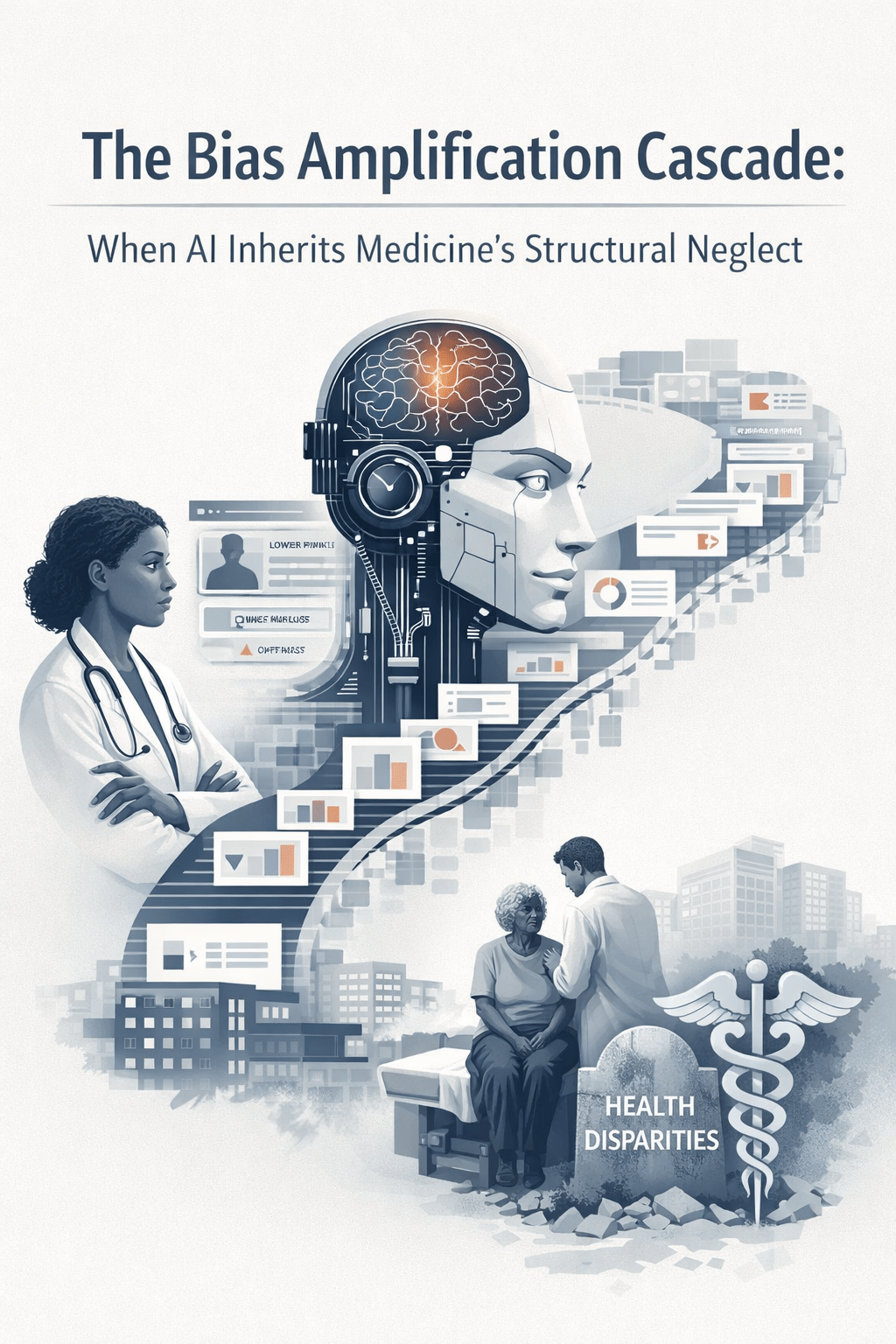
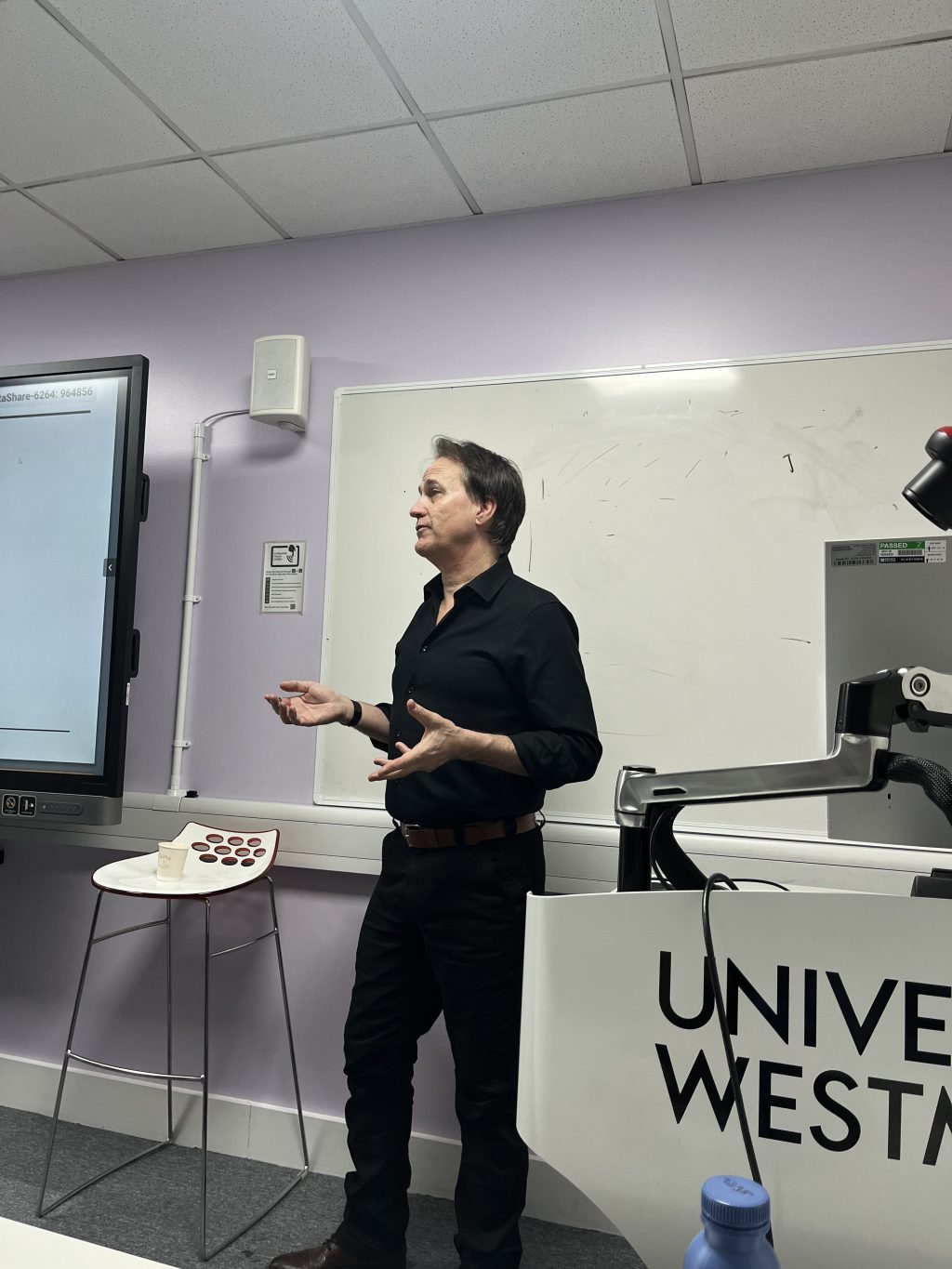
On 17 March 2026, I presented the HEIM framework and the Bias Amplification Cascade at the Molecular Science Research Hub seminar. The core question: what happens when frontier AI models are trained on a biomedical literature that systematically underrepresents most of the world?
The answer, based on two years of empirical work, is that structural neglect compounds. It compounds across three dimensions, and then it propagates into AI.
Three dimensions of compounding neglect
The HEIM (Health Equity Informative Metrics) framework audits research equity across 175 diseases using three lenses.
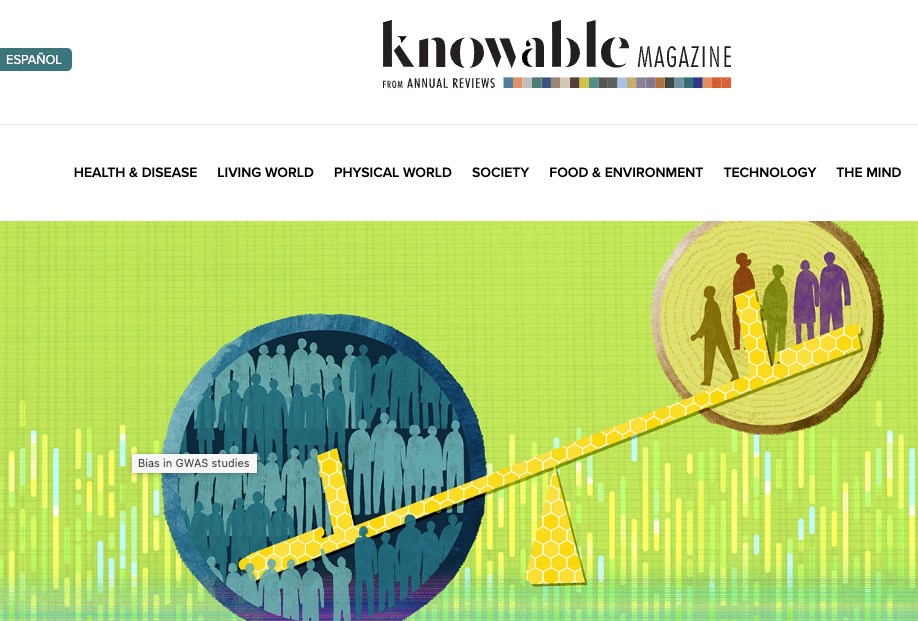
Discovery: We examined 70 IHCC biobanks and their 38,595 publications. The finding that still shocks me: not a single neglected tropical disease has generated a biobank publication. Zero. Across all 70 biobanks. Meanwhile, 93.5% of biobank research output comes from high-income countries. Africa contributes 0.7% of biobank publications despite carrying a disproportionate share of global disease burden.
Translation: Of 563,725 clinical trials with 770,178 registered sites, high-income countries host 71.8% of all trial sites. The US alone accounts for 25%. NTD trials make up just 0.66% of the total, and nearly 40% of those are observational rather than interventional. Praziquantel remains the sole treatment for schistosomiasis after 40 years, with no Phase III alternatives in the pipeline.
Knowledge: Using PubMedBERT embeddings across 13.1 million PubMed abstracts, we measured how semantically connected each disease is to mainstream biomedical discourse. NTDs are 44% more isolated than other diseases (P less than 0.0001, Cohen’s d = 1.80). Eight of the twenty most isolated diseases are WHO-classified NTDs.
The Unified Neglect Score, derived from PCA-weighted combination of all three dimensions, reveals that 9 of the 10 most neglected diseases primarily burden the Global South. And 26 years of data show no systemic improvement.
The cascade into AI
The second half of the talk introduces the Bias Amplification Cascade. We benchmarked 6 frontier LLMs (Gemini 3 Pro, Claude Opus 4.5, Claude Sonnet 4, GPT-5.2, Mistral Large, DeepSeek V3) with 10,500 standardised queries across 175 diseases and 10 knowledge domains.
The central finding: publication volume plus semantic structure explains 66.6% of LLM performance variance. The less a disease has been studied, the less accurately LLMs answer questions about it. And this is not model-specific. All six LLMs show the same blind spots, with a cross-model range of just 0.003 in mean alignment scores. The bias originates in shared training data, not in model architecture.
What makes this particularly dangerous is the domain gradient. LLMs can appear knowledgeable about a neglected disease’s basic biology (aetiology) while failing on diagnostics and health systems. This creates an illusion of competence that could mislead clinicians in exactly the settings where reliable AI tools are most needed.
HIV/AIDS proves this is reversible
One of the most important findings is that HIV/AIDS, despite its origins in marginalised populations, now ranks among the 25% least isolated diseases. Its Knowledge Transfer Potential is 0.999, the highest of any infectious disease. Semantic isolation decreased by 24% over four decades of sustained, coordinated investment through PEPFAR, the Global Fund, and cross-disciplinary research collaboration.
If the trajectory is reversible for one disease, it is reversible for others. But it requires structural investment, not incremental programmes.
Watch and listen
I have made the full presentation available:
Podcast: Listen on Personal Genomics Zone (https://manuelcorpas.github.io/podcast/)
Interactive dashboard: Explore the HEIM data (https://manuelcorpas.github.io/17-EHR/)
Code: Bias Amplification Cascade repo (https://github.com/manuelcorpas/bias-amplification-cascade)
Published paper: Annual Review of Biomedical Data Science, 2026 (https://doi.org/10.1146/annurev-biodatasci-092724-030452)
The evidence is clear. The question now is whether the people building AI for healthcare will act on it.

























 Manuel Corpas
Leave a comment