Wikipedia features as one of the resources with greatest impact in disseminating knowledge. A search in Google for computational biology returns the Wikipedia entry #1 in the hit list (Figure 1). A search for biological databases in Google, again, it returns the corresponding Wikipedia entry top of the list. Search for genomics, proteomics or metabolomics. Still, the top result is Wikipedia.
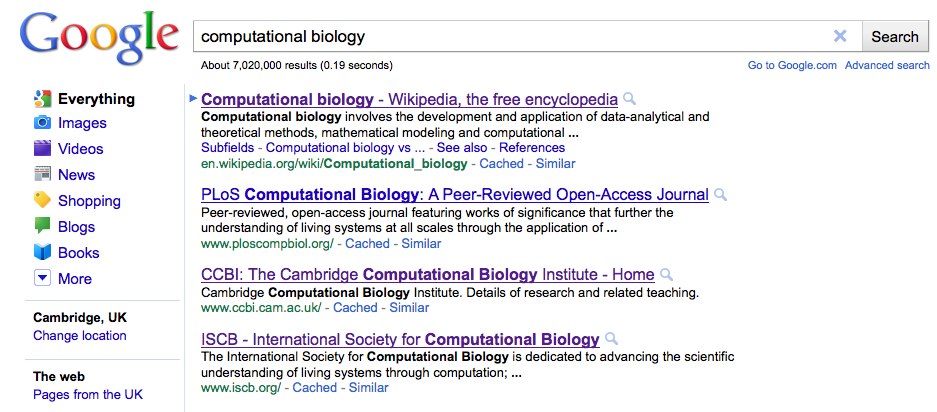
This behavior of appearing top of the hit list in Google happens for most things that are searched in Wikipedia. In fact Wikipedia currently ranks #5 in the list of most visited sites on the Internet. This prominence on Google searches are the result of the great number of links that compose any Wikipedia entry, which in turn is linked by many other entries within and outside Wikipedia.
The success of Wikipedia, initially attributable to the experiment of engaging a community-wide effort to provide accurate and accessible information to the general public has led to a massive development of the resource. Even in scientific circles it features as an important source of reasonably up-to-date reference knowledge [1].
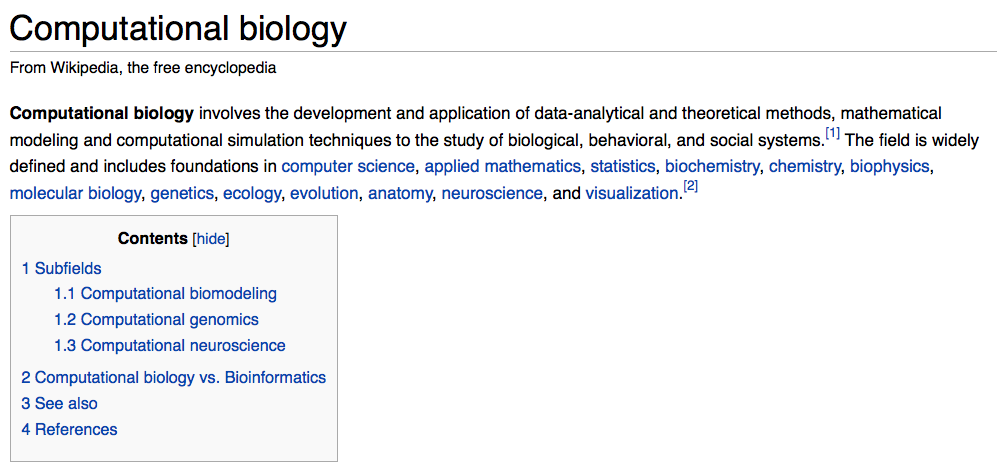
Figure 2 shows a snapshot of the current computational biology article in Wikipedia. It does not mention any of the breakthroughs the field has experienced since the advent of the Human Genome Project or Journals or even Scientists who have shaped the field.
The ability to engage a community-wide effort and the high ranks any entry in Wikipedia occupies in a Google search make it an ideal vehicle for development of dissemination of the significance of Computational Biology. It is the people who work in this field that are ultimately responsible to make sure that their findings and work are known to the tax payer.
[1] http://wellcometrust.wordpress.com/2011/05/18/being-a-scientist-in-the-age-of-wikipedia/











































 Manuel Corpas
Leave a reply to Kevin Karplus Cancel reply