Have you ever wondered why some people have no reparation in sharing their genetic profiles? Why do they openly talk about something supposedly so private? I believe that no contradiction exists between wanting to protect one’s privacy yet sharing one’s genomic data with the world. I am more concerned about the information that Facebook collects about my profile than my genome data (provided that I live in a country where there I public health).
Sharing and comparing one’s genome with other personal genomes is a matter of necessity if one is to shed light on the meaning of one’s personal DNA.
This is why I became a genome blogger myself. Why one should be constrained by the information that genomic test reports provide? No personal genome analysis report can ever be complete, they will always be influenced by the biases of whomever is providing such a report.
* * *
Although no formal document seems to have been produced on what the core values for genome blogging should be yet, core beliefs driving personal genome-sharing should be made explicit. Here I present an initial and inherently imperfect first attempt to put in writing of what I believe genome blogger values could be. I do not expect every fellow blogger to agree with them, but I hope that at least they inspire some debate. These are not a fixed set of rules; on the contrary, I expect this thinking to evolve with the genomics technology itself. I base some of the ideas below on Marcus Wohlsen’s ‘Biopunk’ book, Meredith Patterson’s ‘biopunk manifesto’, Misha Angrist’s ‘Here is a human being’ book and Pekka Himanen’s ‘Hacker’s ethics’ book.
Core Values for Genome Blogging
- Intelligent exploration, experimentation and trial to push the boundaries of knowledge are a right for ordinary people. The days in which genetic science was only done by university professors or people working in corporate labs are now over. Now everyone should have the power and legitimacy to be able to discover, develop and find new things about their own genome data.
- Sharing with the world is more useful than keeping the data to oneself. Whether one wants to share genome data or keep it private it should be a matter personal choice. I have my own right to do what I want with my genome, learn from it, share it with the world or keep it private. Sharing personal experiences about personal genomics findings is a way of creative self-expression and a channel for curiosity to find its way to better self-awareness. Freedom to be open about one’s genome information and the ability to have accessibility to one’s own information is of paramount importance to every human being.
- Whatever attitude a person has towards personal genome privacy, it should be utterly respected. Knowledge of genetics is not as important for informed consent as the personal/psychological attitude of the person. The decision of openness of personal genome data completely resides in the individual and although openness is the better default option, privacy must be utterly respected and not judged.
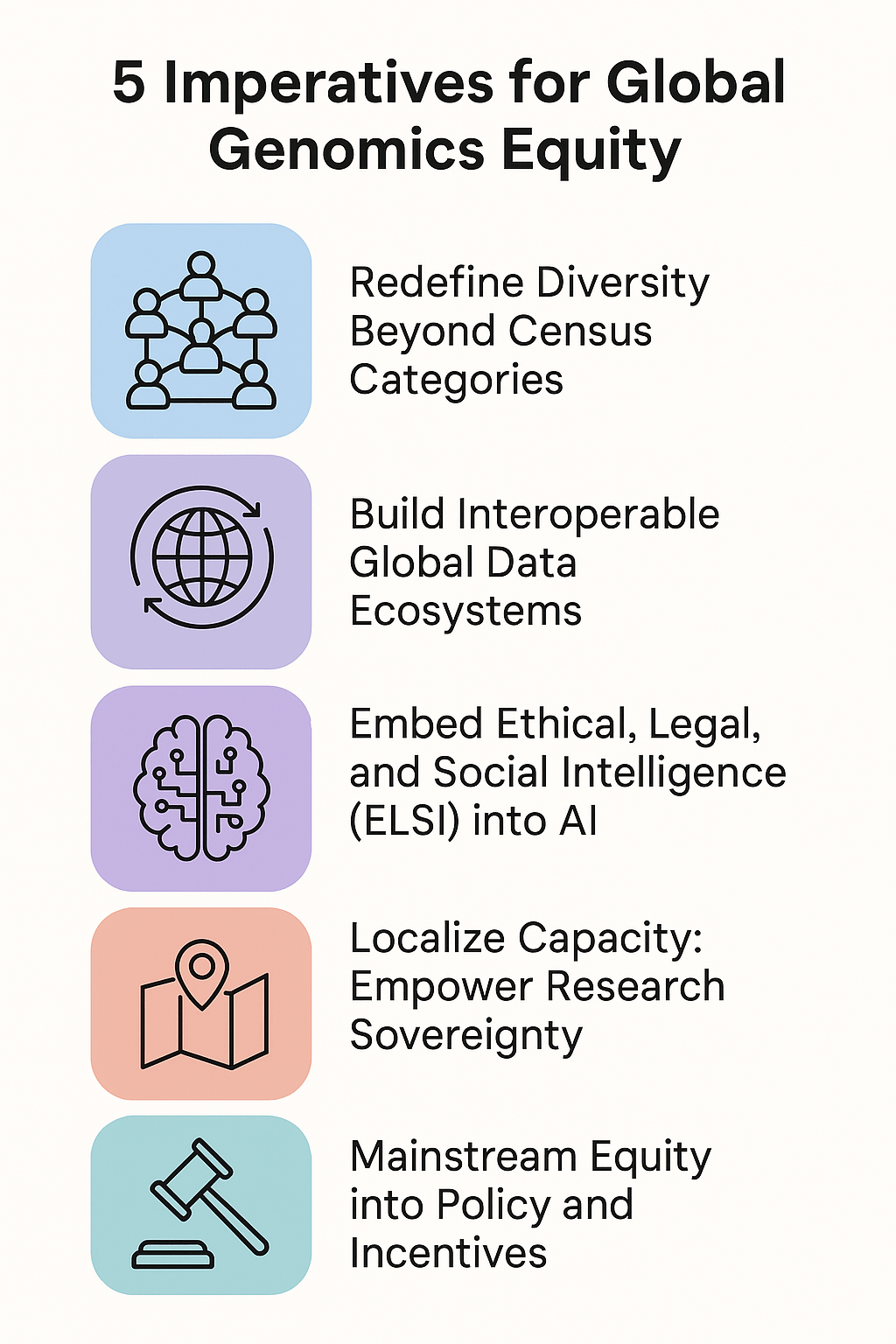
- Personal genome data access should be affordable to all irrespective of nationality, gender, social background or any other circumstance. Whole genome sequencing and tools for its interpretation should become accessible to everyone, not just the realm of those who can pay for it. Genome interpretation tools should be accessible and free for all. Not having access to a personal genetic test is in itself a new kind of discrimination.
- Stating that genetic tests merely provide non-clinical information misses the point of what personal genomics is all about. Genetic risks tests do tell something about one’s health, one’s ability to respond to certain drugs and one’s ethnic ancestry. Trying to downplay the importance of these predictions because we do not have enough statistical discrimination power does not take away the effect such predictions may cause in the recipient regardless of whether they right or wrong.
- Genes affect one’s present but they do not determine one’s future. One’s genetic data is just one more factor among many others in predispositions, risks and behavioural reactions. Genes are affected by the environment as much as the environment is affected by my genes. Although some dramatic genetic diseases can significantly alter one’s life style, genes can never determine the decisions that make us the way we are.
- Education in risks and opportunities for personal genetic testing should be the primary aim of policy makers. Restricting access to interested people makes no sense and it is virtually impossible to ensure. The power of Internet allows anyone to order a test with no need to physically be in any particular location.
- Corporate interest can never compromise any human right. Laws must fully protect individual human rights of equality for every person, irrespective of whatever risks are predicted from genetic data.
- Privacy does not have to be incompatible with openness. Knowing one’s bank account movements are probably a better reflection of oneself than a personal genome.
Conclusion
Genome blogging is about sharing the thrill of discovering uncharted territory. Sharing one’s experiences on the Internet may help start answering personal questions without having to wait for others to find out. The challenge of personal genomics does not lie in the sequencing itself but in the interpretation of results. The wide access to the technology to the public is driving some policy makers to exert a “protective” approach to keep users away from unpredictable or undesirable “potential” consequences. However, legal and health systems seem hardly suited to keep up with advancements. It is pointless to restrict access to genetic testing: education in risks and opportunities seem a more reasonable approach. Despite the ease with which it is now possible to access one’s genome data, the personal genomics field is still inaccessible to most people.




























 Manuel Corpas
Leave a comment