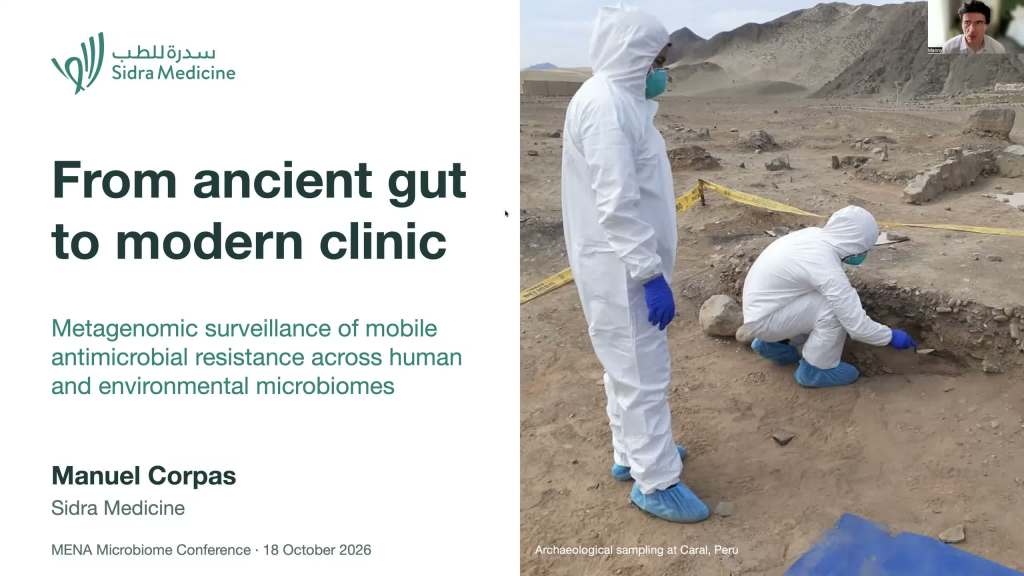
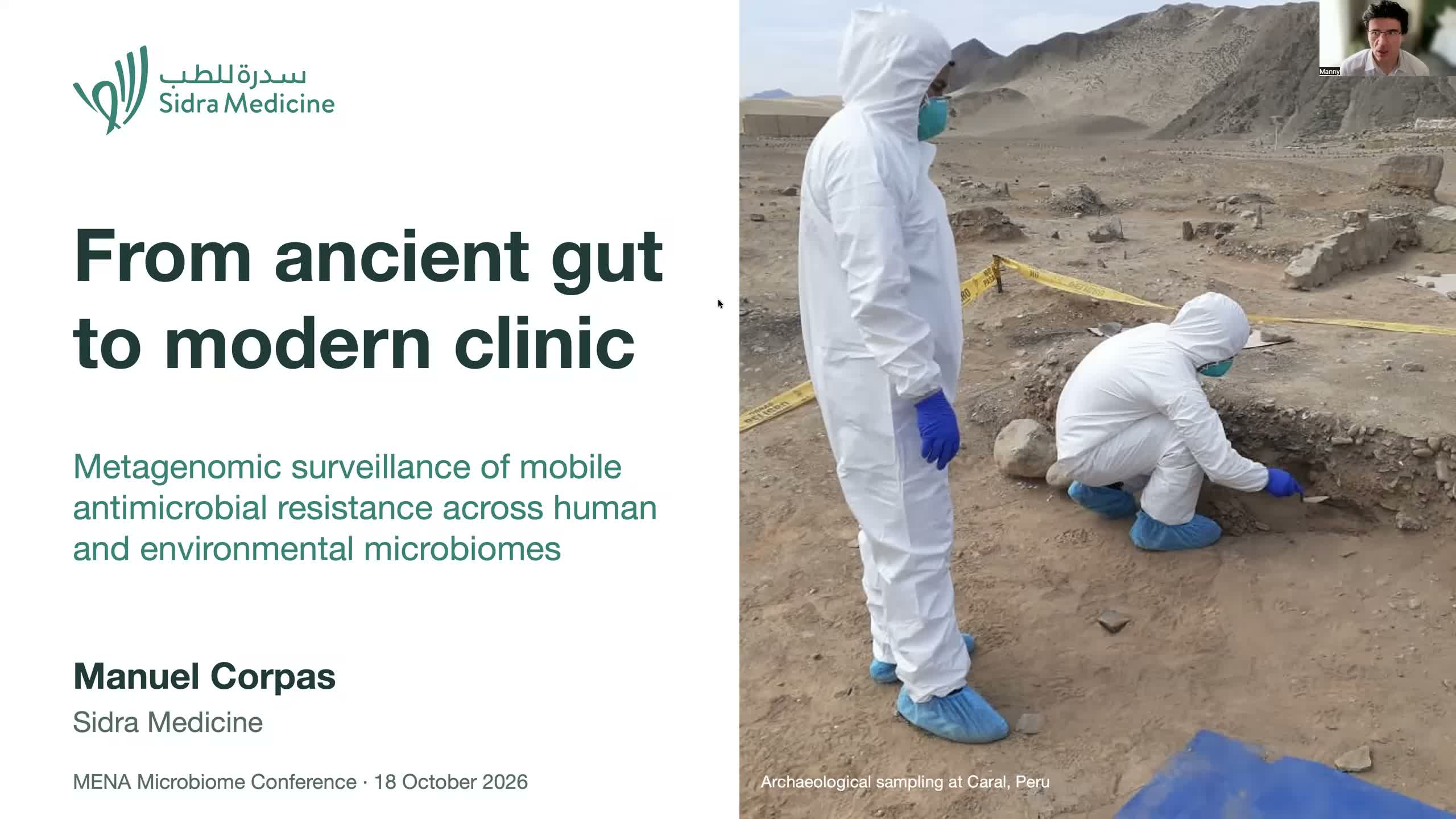
Metagenomic surveillance of antimicrobial resistance. My presentation recording for the MENA Microbiome Conference 2026, Doha.
Watch the presentation on YouTube.
Listen to the podcast version.
When does a resistance gene become a clinical threat?
That question runs through my presentation for the MENA Microbiome Conference at Sidra Medicine, Doha, on 18 October 2026. The work begins in Peru, with archaeological samples from Caral and wastewater from Huánuco. It also includes a result that changed when we changed how we counted.
The presentation discusses unpublished research. The numerical findings below are from our study and its corrected archived analyses, rather than a peer-reviewed publication.
A small p-value, a fragile interpretation
Our comparison contained 274 shotgun metagenomes: 268 from public archives and six from Huánuco. The 18 Caral coprolites were a separate 16S amplicon collection and were excluded from the resistance comparison. The eight ancient gut metagenomes came from the public archives, not Caral. Caral’s bacterial data involved whole-genome amplification and lacked sequenced extraction blanks; fungal evidence of faecal origin does not authenticate every bacterial sequence.
Using raw mapped reference counts, the fraction annotated as acquired was approximately 31% in historical samples and 55% in modern samples, with p = 3.5 × 10⁻¹⁷. That looked like a strong historical expansion.
We kept the samples fixed and tested alternative estimators. After adjusting for reference length and excluding two rpoB-family references as a sensitivity analysis, the fractions were approximately 62% and 65%, with a difference of about 2.51 percentage points and p = .234.
This does not establish equivalence, absence of an effect, or the superiority of the combined estimator. Excluding those references does not show that their sequences lack resistance. It shows that our original historical interpretation depended on the measurement.
The comparison also confounds time with specimen and study: 157 of 165 historical samples were dental calculus, while the modern group contained no calculus. The shared broad gut compartment comprised eight ancient and 20 modern samples, still with different study and processing histories. This archive cannot isolate an effect of time.
What six wastewater samples can tell us
The Huánuco collection covered urban drainage, the Hermilio Valdizán hospital and the EsSalud health centre, with two sampling days at each site. Six samples cannot establish population prevalence or a general hospital-versus-community effect.
They can reveal observations worth following. The microbial and resistance-reference profiles differed across samples. For six selected resistance references, mapped reference coverage ranged from 98.69% to 100% in every sample. Their annotations represented four mechanisms: target protection, drug inactivation, target alteration and replacement enzymes.
These are sequence-detection results. They do not establish expression, an intact assembled allele, susceptibility phenotype, host identity or transfer. Fractions of annotated reference-mapped counts are not percentages of bacteria or absolute resistance burdens. Finding a bacterial genus and a resistance gene in the same wastewater sample does not connect them in a genome.
Gene, host and genetic context
Resistance predates clinical antibiotics. D’Costa and colleagues reported resistance determinants in 30,000-year-old Beringian permafrost in Nature. Their finding provides evolutionary context; it does not authenticate our samples.
For surveillance of mobile resistance, detecting a gene is one part of the question. We also need to establish the host and the surrounding genetic context. A reference annotation of acquired resistance is not a measurement of mobility. A sequence match alone does not identify an individual infection or choose a treatment.
The distinction matters when moving between patient isolates, gut samples, oral biofilms and wastewater. Each represents a different biological mixture and answers a different question. Broader sewage research, including Munk and colleagues’ study across 101 countries, places these environmental measurements in a wider surveillance context. Our small Huánuco collection is a descriptive local study, not a comparable global survey.
Our archived annotations used RGI and CARD. Alcock and colleagues describe CARD’s curated resistance detection models, but using the same software name does not make differently collected and processed samples a harmonised experiment.
Lessons for surveillance
The practical lessons are to define the catchment, sample repeatedly, connect metagenomic signals with isolates and susceptibility testing where clinical interpretation is intended, and preserve the full measurement record. That includes specimen, date, controls, database version, model types, mapping settings, thresholds, count field, length adjustment and denominator.
These are design lessons from Peru. We have not validated a surveillance protocol for Qatar or MENA.
The historical headline did not hold. The observations and questions remain. Who carries the gene? What surrounds it? What does it mean in this setting?
Resistance is ancient. Clinical risk depends on context. The measurement deserves as much scrutiny as the result.
With thanks to Luis Jaramillo-Valverde, Ruth Shady, Pedro Novoa, Heinner Guio, the Caral Archaeological Zone, participating communities, field and laboratory teams, and the researchers who shared their data. I founded ClawBio.ai and Cambridge Precision Medicine.
































Leave a Reply